- Learn With Us
- Visit Us
- Opportunities
- About Us
 Enriching lives through arts & crafts for 100+ years!Our History
 - Support Us



Sandra J. Blain Galleries
By necessity, growth requires an acknowledgement of the past as a precondition for understanding the present. Be it a seed’s first tender stem surfacing from the soil or a cell’s multiplication by splitting in two, growth builds on the past to create new realities. The artists featured in the exhibition Patterns of Growth—Yael Braha, Megan Koeppel, Anela Ming-Yue Oh, Tyler Quintin, and Jada Patterson—exemplify this duality. During their 2022 – 2023 residencies at the Arrowmont School of Arts and Crafts all five artists took their existing artistic practices in new directions. Together, what results is an explosive exhibition of ambitious new work.
– Kelli Fisher, 2022-2023 Kenneth R. Trapp Craft Assistant Curatorial Fellow

Born in Italy and daughter of refugees from North Africa, Yael Braha creates functional, sculptural, and wearable ceramic work.
Both my parents escaped from Libya with a suitcase in one hand and hope one the other: they left everything except their knowledge, becoming refugees, and starting their life anew in their country of asylum – Italy. As a result of this displacement, I have come to cherish the notion of “acquiring knowledge” and skills – as opposed to “acquiring belongings,” which has led me to learn and experiment in various art fields throughout the years – from graphics design, to cinema, to metal fabrication, and ultimately, ceramics.
I create black and white functional ceramics with bold and stylized surface designs which feature optical and geometrical illusions, patterns and tessellations. I use lines and curves to distort and add dynamism to the surface of my work, and I use seams and negative spaces to create contrast and tension within a form. The surface pattern reliefs add a surprising tactile experience when the work is held, touched, and used. The way that patterns are framed within a form, where they are cut, assembled, and overlapped, allude to the process of film editing – splicing two shots together to create a third meaning.
My ceramic sculptural work is influenced by my upbringing and it explores dichotomies of containment/displacement, erosion/accretion, migration/residency and themes related to survival, resilience and transformation. In my wearable work I use thread to weave wood-fired and electric fired clay elements into metal backbones, creating stylized skeletal structures that can be hung or worn. These worn elements encompass both fashion and function, making a statement about beauty and safety.

Yael received her BA from the European Institute of Design in Rome, and her MFA from San Francisco State University. Her work has been exhibited nationally and internationally at museums, galleries, and festivals. In 2021 she was awarded the Multicultural Fellowship Award from the National Council on Education for the Ceramic Arts (NCECA).

Megan Koeppel is a textile and fiber artist originally from Milwaukee, Wisconsin. She uses her background in painting and textile to create contemporary quilts that explore natural dye and traditional quilting.
While quilting is often associated with being hand-made and its close relationship with the body, it rarely depicts the human form. In my most recent work I use screen printing and appliqué to bring the female figure into quilting, as an acknowledgement of labor that has often gone unrecognized. Many individuals grow up with some association to quilting, and often learn to quilt or mend from a family member. My introduction to quilting has been a little less conventional. At the start of my art education I was searching for female and queer mentors and artists outside of academia. This brought me to working with FORCE, based in Baltimore, MD, on their Monument Quilt Project which collected thousands of stories from survivors of rape and abuse. The final culminating display was exhibited on the National Mall in Washington DC in the summer of 2019. By working with the Monument Quilt Project I found quilting to be as much a tool for activism as it is a tool for healing.
I have carried this healing over to my more recent work where I am seeking to provide a healthy re-examination of the female form. I grew up looking at Matisse paintings and paper cut pieces. While I admired their aesthetic value, I rarely thought about the women being depicted–let alone how they were being depicted. In many of Matisse’s renderings of the female body, the forms are often headless or handless with unrecognizable faces. In my recreations of these figures I am literally reintroducing images of the hand, bringing a female creator’s control and contribution back into the image. Drawing from my own visual language while referencing the style of many male modernists, I seek to create gestural figures that are not often seen in conventional quilting. The works in Patterns of Growth show the healing and play that has happened over the course of my time in this residency.
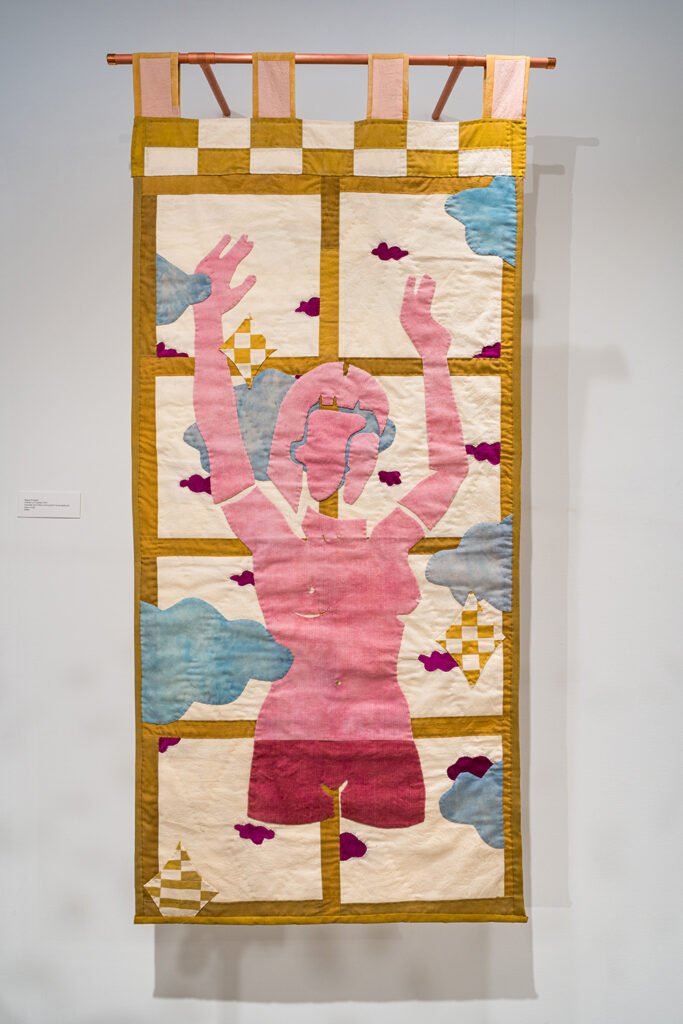
Megan received her BFA from the Maryland Institute College of Art where she studied painting and curatorial practices.She has exhibited mainly in her home state and on the east coast in galleries and museums such as: Walters Art Museum (Baltimore MD), VisArts Art Center (Rockville MD), Material Gallery + Studio (Milwaukee, WI) and The Wisconsin Museum of Quilts and Fiber Arts (Cedarburg, WI).

Anela Ming-Yue Oh 胡明月 is a multidisciplinary artist in love with curry and the ocean. She uses materials that have a life of their own such as clay, paper, and fiber to feed her studio practice and create environments full of hope. As a mixed race artist of Malaysian Chinese descent, her visual language draws from her heritage as a reminder that there are reservoirs of strength we can draw upon from those who have passed away to imagine and construct new futures.
I look to the richness of my cultural history, the natural world, and those who have passed away as resources in constructing worlds. The worlds I create aim to acknowledge these ever-present resources while imagining futures full of healing. In my artwork I draw from the narratives, traumas, and gifts of being mixed-race: Malaysian-Chinese, and white. My visual imagery is full of references to batik, a wax-resist dyed fabric often worn in the form of a sarong (wrap skirt). The history and processes involved in batik are a cornerstone to my practice as I reimagine and reclaim the natural and patterned landscapes of my cultural heritage. Often these reclamations involve inserting root systems and fruit of plants into traditionally derived batik patterns to speak to intergenerational, transcontinental connections. One of the main plants that repeatedly shows up in my fabricated batik language is okra. Okra, a member of the hibiscus family, has beautiful flowers that fit naturally into the floral history of batik and serves as a way to honor my maternal grandmother and great-grandmother who were sharecroppers in South Carolina, as one of the crops they would grow for themselves in their garden while laboring in the fields on others farms. Using this visual language I weave a multitude of materials through my work to consider the layers inherent in connection. Materiality lends itself to complexity, strengthening the bonds between that which seems diametrically opposed: soft fiber and hard ceramic, plastic and natural, to remind us that there is richness and beauty in that which is seen as other.
Batik is meant to be worn, the environments depicted blending into everyday life. I seek this visual abundance and the proliferation of growth motifs intertwining with the human, the mystical, and the natural. Beauty is an integral part to healing. I integrate the worlds I imagine into objects and spaces that reference home. A cookie container, lychee jelly jar, a brightly colored colander filled with green, wild growth. I love the imagery of propagation within the context of the immigrant household. The worlds we imagine can coexist with our daily lives, growing every day as we provide care and attention for them to flourish. If long-lasting effects of trauma exist to prepare you for being on the verge of death at any moment, when we invest in caretaking and creating we are investing in a new future, in healing, and in living. Abundance is the moment of joy in finding what you have gently raised has transformed and flourished beyond imagining. The fruits of the seeds and brokenness you started with weaving themselves into worlds all their own. How then can these worlds find awkward and joyful places in our everyday lives to exist in reciprocity with healing?
I desire abundance: of beauty, of growth, of imagining new futures. These works are a reminder that there are reservoirs of strength I can draw upon from those who have passed away as I try to imagine and construct new futures. Those we have lost: their labor, and their love, are resources that are always available to us as we navigate this world.

Anela holds a BFA in Studio Art from the School of the Museum of Fine Arts at Tufts University.She has been an Artist-in-Residence at Sonoma Ceramics, a Teaching Artist-in-Residence at the Oxbow School, and the 2021-2022 West Bay View Fellow at Dieu Donné Papermill. She will be traveling to Malaysia as a SMFA at Tufts Traveling Fellow in 2023.
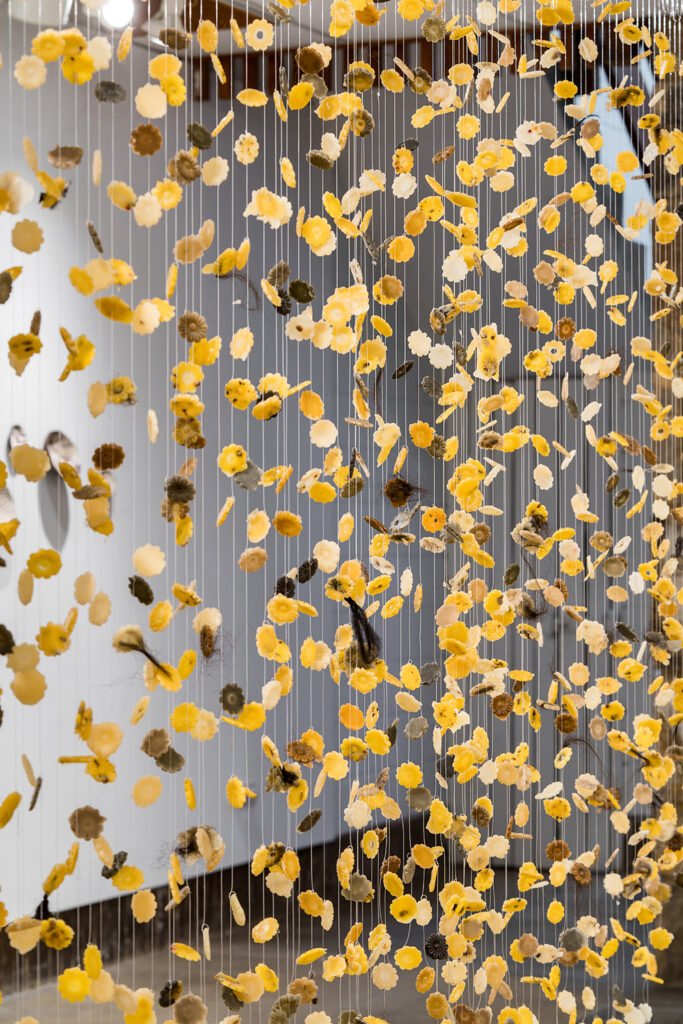
Jada Patterson is an artist and gallerist born and raised in Milwaukee, Wisconsin. Her studio practice is multi-disciplinary as she makes work primarily in clay and beeswax exploring the human condition pertaining to identity, material culture and adornment.
The intersections of identity, material culture and personal histories are the basis of my work. I am deeply interested in Black traditions of hair and body adornment. These traditions are often embedded into my work, as adornment was a passageway for stepping into my womanhood.
My work consists of delicate hand sculpted and cast objects in predominately clay and beeswax, as well as found objects used for assemblage. The ways in which I think of objects, material, texture, color and clay body all reference the human body. The beeswax I work with is used as a protectant and sealant in my work, but also acts as a stand in for the body. This material makes up a large part of my work; as it pays homage to the patriarchs in my family who bee kept in the rural south and the matriarchs who hats I cast in beeswax to seal in their legacies. Through my art I work to honor those who raised me by vehicle of materiality and reveal the human commonality we feel in death, adornment and ritual.
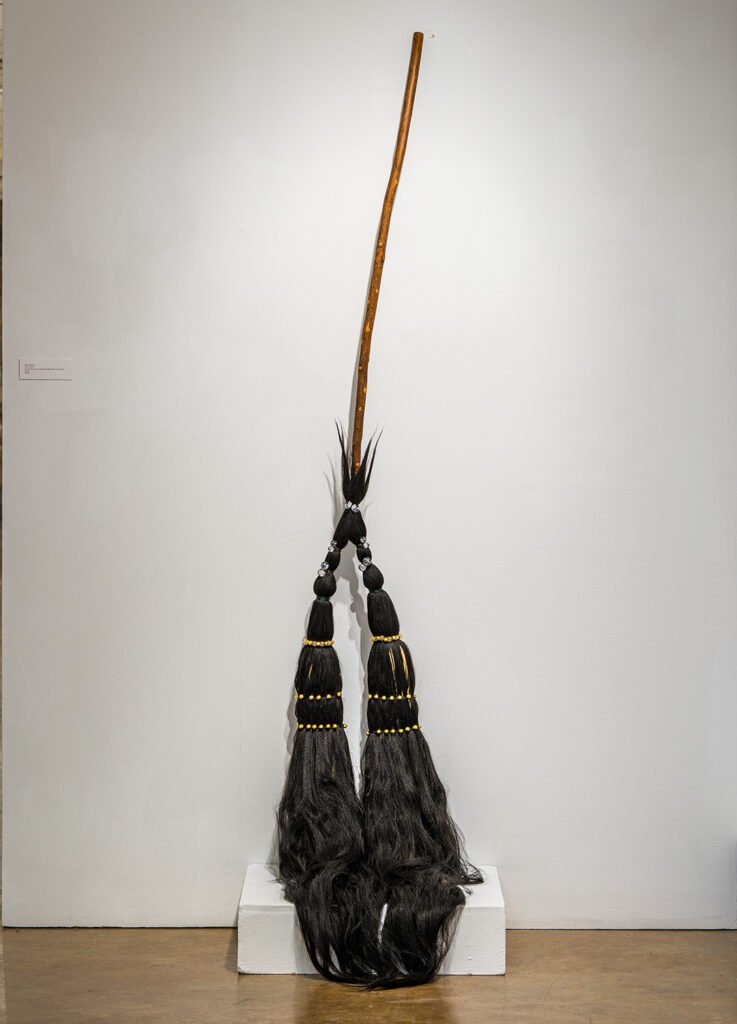
Jada is a graduate of the Kansas City Art Institute where she received her Bachelor of Fine Arts in Ceramics and Art History. Her curatorial practice centers, but is not limited to Queer and BIPOC sculptural artists. Jada has attended fellowships and residencies at the Ox-Bow School of Art and Charlotte Street Foundation.
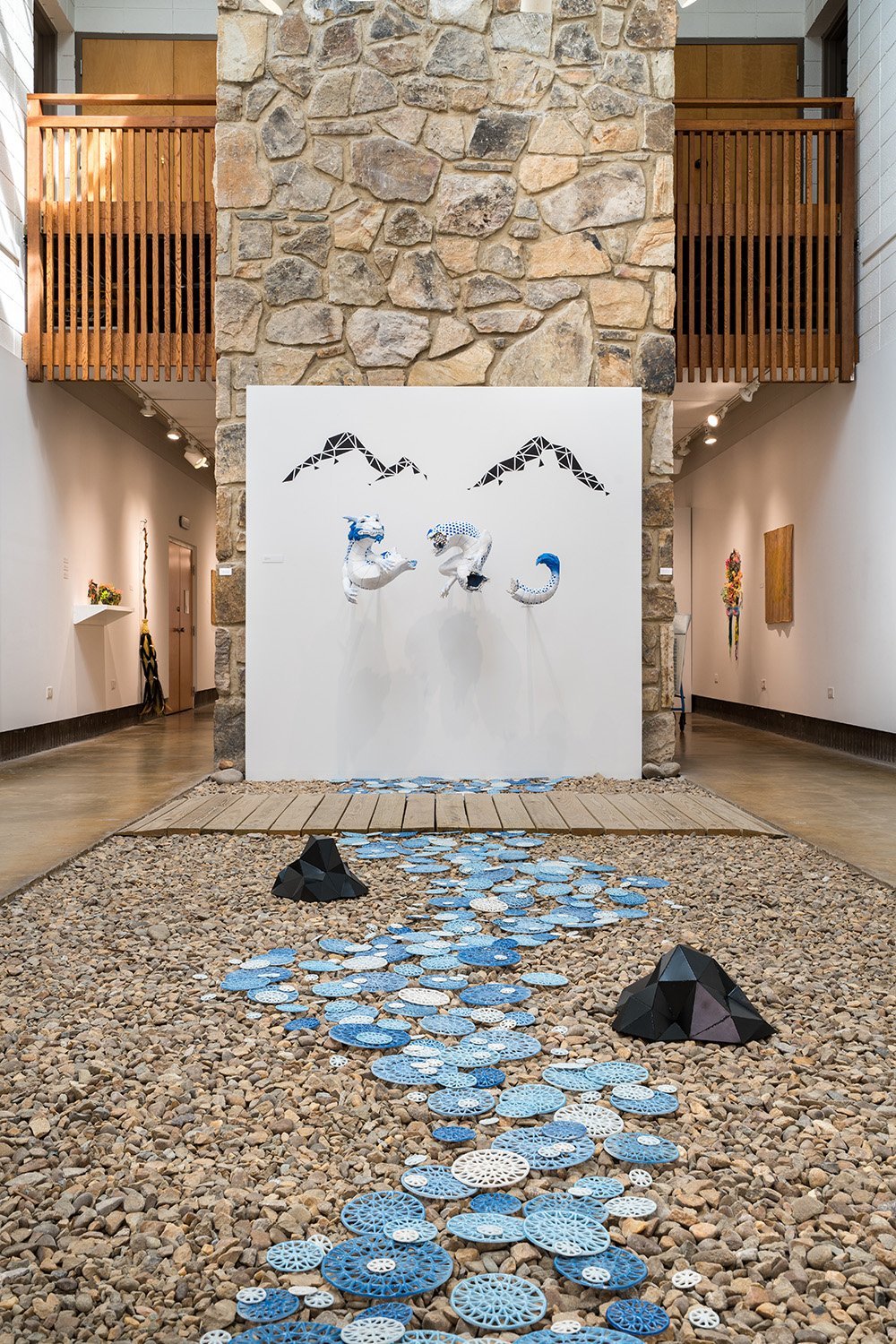
Tyler Quintin received a BFA from Washburn University in 2016 on a full tuition merit scholarship. This opportunity afforded him the facilities to explore work across a variety of mediums, which eventually led to a transition from drawing to ceramics.
My work explores the internet’s role in both navigating and understanding my mixed race, Korean-American identity and my queer identity. I was raised in the midwest with a culturally white-American upbringing; my physical features being the only ties to my East-Asian descent. Clay is my primary medium because it is the first material where I was taught something with historical ties to my Korean heritage.
The internet fascinates me both in its ability to offer fast, immediate information, as well as its ability to foster space for online communities centered around different subcultures. On the one hand, a quick Google search allows me to research information about my cultural heritage; however, it is simply a glimpse, abstracted and divorced from lived experience. My online research, while important, facilitates no real sense of connection. But connection is the key component of online communities, where online platforms allow interactions between individuals from all over the world while providing safe spaces in which to explore queer identity. Often these spaces use abstraction intentionally, allowing people to explore their identities, interests, and sexualities anonymously through avatars and icons.
Taking visual inspiration from character icons, historical research, and the wire frame structures used in 3D modeling software, I fragment my vessels and figurative work. This rendering versus fragmentation communicates both the authenticity of online interactions and the knowledge gained from research, while acknowledging the gaps where something is missing.

Tyler has completed residencies at the Morean Center for Clay in St. Petersburg, FL and the Haystack Mountain School of Craft in Deer Isle, MN. Tyler Tyler’s work has been exhibited in numerous national and international exhibitions, including venues such as the Archie Bray Foundation for the Ceramic Arts (Helena, MT), the San Angelo Museum of Art (San Angelo, TX), and the Lancaster Museum of Art (Lancaster, PA). His work is featured in the permanent collections of the Mulvane Art Museum (Topeka, KS) and the San Angelo Museum of Art.
Please join us for a reception on Friday May 12, 2023 from 5:30 – 8:30pm. Free and open to the public.
All work photographed by Robert Batey.
