




“When I was a little girl I would lay down on the floor and get my pencil and draw. I would draw all different things and after I finished drawing I would go in the kitchen and steal some flour, make it up into dough, and stick the drawings up on the wall. My sister would say, ‘Mama, make Nellie quit putting those drawings up,’ but Mama would let me go on doing it.”
Rowe described her experiences growing up on a sharecropper farm, and the work her own mother did to take care of a family with 10 children and multiple grand-children. Her father was a basket-maker and blacksmith, as well as a farmer. “My Mama did everything. She was busy all the time; she made quilts and taught me to make them. Thank the Lord we are here now because I couldn’t go through what my Mama went through being as smart as she was, waiting on all those children and grandchildren. She stayed home and cooked and was satisfied. I know she got tired being at home. I favored my daddy more than my mother. I’m short like him, but not as smart.
Daddy was a smart worker and he kept us in the field doing all kinds of work: picking cotton, chopping cotton, hauling corn and watermelons. We had a big apple orchard and we would haul the apples to the barn. We plowed with the mules, Molly and Mike. I plowed with Molly; I plowed with Mike. I talk about it, but I didn’t like to plow. I didn’t like to do anything in the field. I also fished, but I didn’t like to fish. I just liked to draw and make dolls.”

At 16, Rowe ran away and married her first husband, Ben Wheat. The two did farm work before moving to Vinings, GA, a rural area northwest of Atlanta. There, Rowe began working in the home of the Smiths across the road from her home. After Wheat’s death in 1936, she met and married her second husband, Henry “Buddy” Rowe, an older widower. When Henry died nine years later, Rowe, now aged forty-eight, devoted her full attention to her art making.
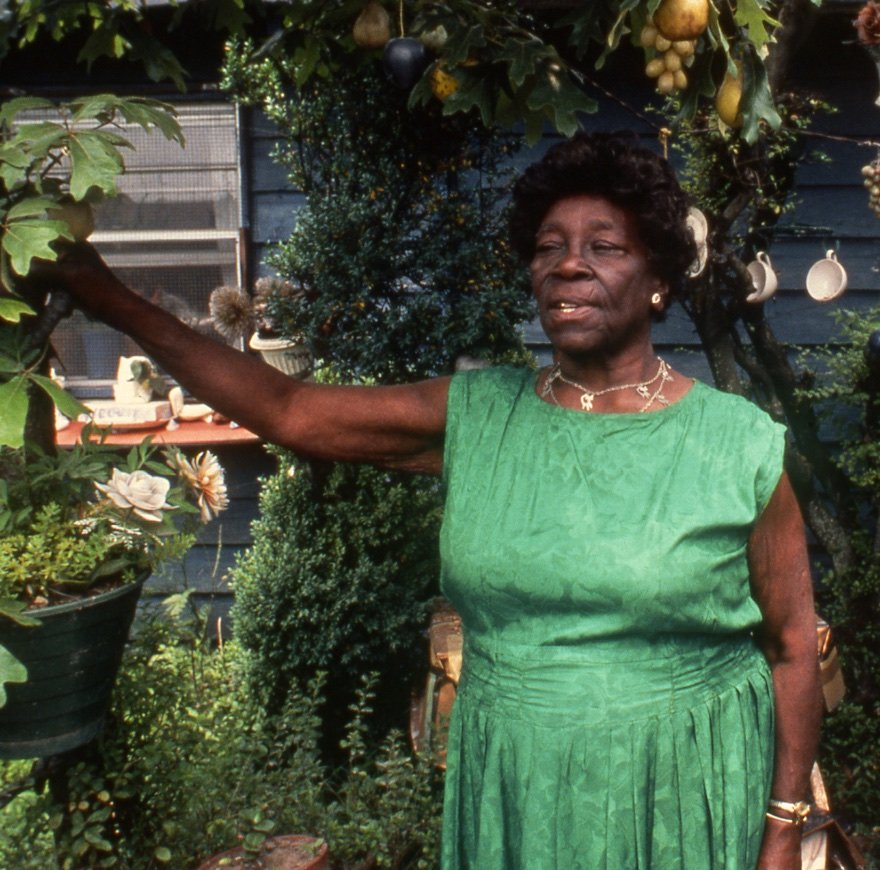
“I didn’t hang anything outside or draw while Henry Rowe was alive. When he died in 1948, I started hanging things in the yard, in the trees and bushes.
I said, “Now I’m going to get back to when I was a little gal playing in the yard, playing in my playhouse.”
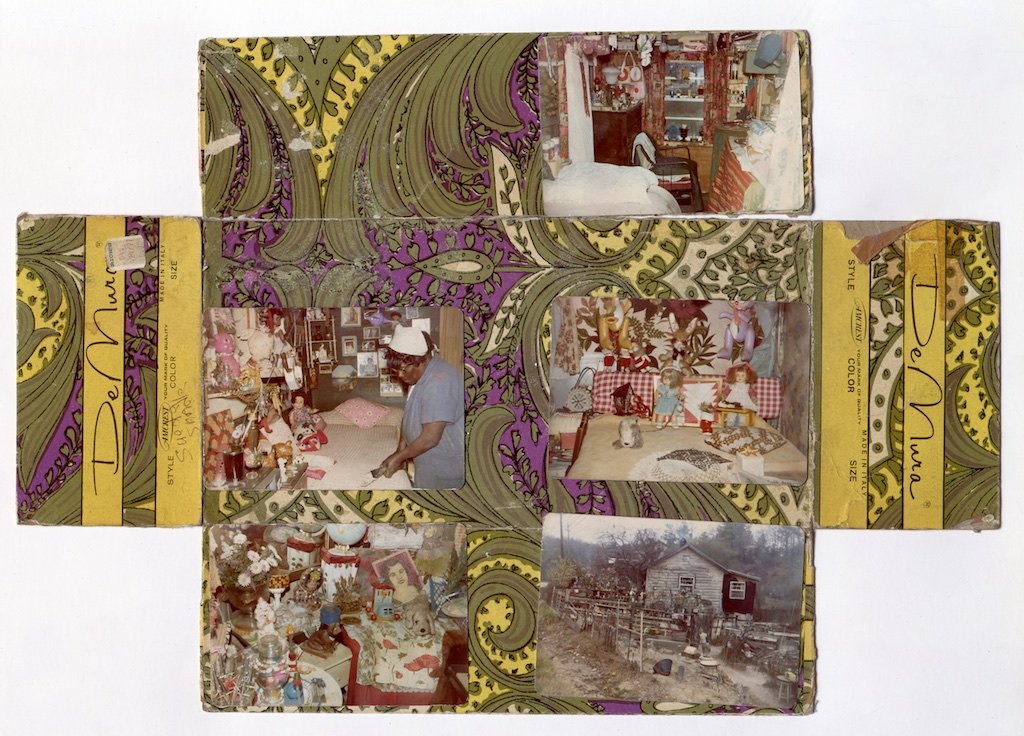
The yard was decorated pretty. Because of the talent God gave me, many people started visiting and taking pictures. What is exciting and surprising and makes me feel good is to think about the people I would never have seen if I had not been doing things that were interesting to them. Folks brought me all kinds of things: dolls, stuffed animals, beads, bottles, and sometimes strangers would leave things at my gate. I would place them in my yard and some I would hang indoors against the walls. Everything else, other than what people gave me, I picked up. I like it when things keep on changing; keeps me busy.”
For the next three decades, Rowe exhibited her dream-like, visionary work in and around her home, attracting many visitors. At her yard shows, she displayed her treasure-trove of vibrant drawings, decorated dolls, chewing-gum structures, and plastic flowers. She was also a performer at these shows, frequently singing gospel songs on her electric organ.
In the late 1960s, as the Black Arts and women’s liberation movements were bubbling across the country, Rowe seized the opportunity to write her own narrative. She drew her name around the words “really free”—the title of a Bible Society leaflet she’d received in the mail.
“When other people have something they don’t know what to do with, they throw it away, but not me. I’m going to make something out of it. Ever since I was a child, I’ve been that way. I would take nothing and make something.”
In 1978, she caught the attention of the late Atlanta gallerist and art collector Judith Alexander, who befriended and represented Rowe. Alexander included Rowe’s work in the 1976 exhibition “Missing Pieces: Georgia Folk Art 1770–1976,” exposing her to larger audiences for the first time.
Highly religious, Rowe claimed her artistic vision came from God. “In my home, there were nine girls, and I was the only one who didn’t have children . . . but He gave me this gift. He is the One who gave me this hand.
I just draw the way I see things. I see people crippled and I may draw them to ask the Lord to help them. Nothing I draw I draw to make fun of. I draw what I see of people’s condition and I ask the Lord to help them.
I don’t know why He put me here but He has me here for something because I don’t draw like anyone else; I don’t try to draw like anyone else. I see what I draw in my mind late at night and I don’t care how crazy it is, I’ll probably draw it.”
Rowe died on October 18, 1982 in Vinnings, GA. Today, her works are held in the collections of the Smithsonian American Art Museum in Washington, D.C., the High Museum of Art in Atlanta, and the Metropolitan Museum of Art in New York, among others.
Sources and Resources
https://www.soulsgrowndeep.org/artist/nellie-mae-rowe
https://americanart.si.edu/artist/nellie-mae-rowe-4170
http://www.artnet.com/artists/nellie-mae-rowe/
