



 Isaac Scott Hathaway was a sculptor, ceramicist and educator who famously crafted more than 100 busts and masks of prominent African Americans and was the first Black artist to design U.S. coins.
 Isaac Scott Hathaway was born in 1872 in Lexington, Kentucky to Rachel and the Reverend Elijah Hathaway, the middle of three living children. He was raised by his father after Rachel’s death in 1874; his sisters were sent to be raised by their grandparents. Hathaway provided rare descriptions of his father’s life as a slave in Bourbon County during an interview for the Federal Writer’s Project in 1939 (Perry 1939).“That dad of mine was great…even though he was a slave, he managed to learn to read and write when a boy.” His father provided Isaac with a good education and a pivotal trip to a Cincinnati art museum at the age of nine. While attending the museum, Isaac and his father viewed busts of famous Americans – all depicting white individuals.
Isaac couldn’t find the bust of his hero, abolitionist Frederick Douglass. Reverend Hathaway explained to his son that, at that time, there were no trained Black sculptors who could provide the public with statues and busts of prominent African Americans, and that while there were many important and famous Black individuals who deserved to be honored, their likenesses would not be displayed in public places. Determined, young Hathaway responded, “I am going to model busts of [African Americans] and put them where people can see them.”
Hathaway went on to Chandler College in Lexington, Kentucky and Pittsburg Normal College in Pittsburg, Kansas where he studied ceramics. He also enrolled in the Art Department of the New England Conservatory of Music in Boston. While in Boston he sculpted his first bust, and his subject was Bishop Richard Allen, the first bishop of the African American Episcopal Church. His first formal training in ceramics came from Cincinnati Art Academy, followed by Cincinnati Art Academy in Cincinnati, State University of Kansas and in the College of Ceramics at the State University of New York at Alfred. After graduating, Hathaway returned to Lexington where he used his diversified education and art background as a school teacher in Kentucky.

Hathaway taught at Keene High School from 1897-1902. He opened his first art studio in Lexington, where he made plaster parts of human anatomy for educational and medical uses. He and his father cleaned out the chicken coop in the backyard of the family home to open Isaac’s
“Studio of Sculpture.” He quickly secured commissions, including a model of Old Morrison Hall for Transylvania University, life masks for poet Paul Laurence Dunbar and congressman W.C.P. Breckinridge, a death mask for abolitionist Cassius M. Clay and a bust of journalist R.C.O. Benjamin. A versatile figurative artist, Hathaway was able to work with large figures as well as miniatures, and was the first artist to make death masks of prominent African Americans.
 Soon his work gained notice. His artistic skill made national news when William M. Bullitt, an attorney in Louisville, hired Hathaway to make the plaster mold of a crime scene; the tree and surrounding ground where a man allegedly committed suicide. Hathaway colorized the plaster model so well the opposing attorney – thinking it was the actual tree – accused Hathaway of “mutilating” the crime scene.
In 1907 he moved to Washington D.C. and began making sculpture busts of famous African Americans, including his hero, Frederick Douglass.
Hathaway’s company became known at first as the Afro Art Company, and later the Isaac Hathaway Art Company. He did produce busts of many famous and prominent African Americans for distribution to schools and elsewhere. Among his works were: Booker T. Washington, Richard Allen, Paul Laurence Dunbar, George Washington Carver, and C.C. Spaulding and others. He molded plaques and masks which could be hung on walls of colleges, churches, and business’. Hathaway also sculptured in bronze metal upon request.

Throughout his long career, Hathaway constantly experimented with clay to create a wide range of ceramics and sculptures. He also learned how to create natural colors when he accidentally broke the limb of his father’s favorite peach tree. He recounted an incident during childhood where he first experimented with natural pigments and colors:
To my consternation the whole limb came down, peeling the bark for several inches. Knowing that my father would soon return from his church duties I hastily instructed my younger sister to gather all the peaches from the limb while I ran into the house, secured my box of paints and painted the scar a deep Van Dyke brown. It looked as if it were almost decayed. The scar was retouched with turpentine several times until it did not shine, and the detached limb was hastily deposited in a rock quarry several yards from the house. When dad came he missed the big limb from the tree but for his life could not account for it as he did not see any scar. To this day, although this incident helped me in coloring, I always feel guilty of having deceived my father.
In 1915, Hathaway offered the region’s first course in ceramics at a Black institution, Branch Normal College (now the University of Arkansas at Pine Bluff). He taught there and at a high school in Pine Bluff until 1937. He married Pine Bluff native Umer George Porter and the two moved to Tuskegee, Alabama to establish the Ceramics Department at Tuskegee University.
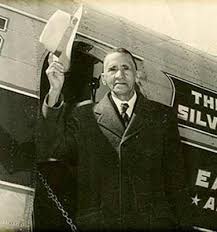
In 1938, Father Bruno Drescher of Chicago, Illinois, commissioned Hathaway to model a sculpture of the Catholic saint Martin de Pores. In addition to the commission, Drescher requested 100 statuettes. After receiving the statuettes, Drescher praised Hathaway’s talent, saying, “I do not believe there is a sculptor in the United States who can excel you in producing a likeness.”

 In a Federal Writers’ Project interview conducted in 1939, Hathaway compared the molding and shaping of clay to the molding and shaping of children. He said: “This reminds me of our duty to our children. They should be shaped into usefulness as they grow.”
As he lived and worked in Alabama, it is not surprising that his favorite medium contained Alabama clay. After years of working with his mixture of clay, he developed a method that gave the final product a translucent quality. At one time during his career, Hathaway was a sculptural designer for the New National Museum of the Smithsonian Institute.
Hathaway made an important discovery in 1945 when he developed Alabama kaolin clay as a medium, and he became the first artist on record to “make the clay behave.” The following year, Hathaway was the first African American to design a U.S. coin.
During his life, Hathaway designed two U.S. coins. His first was the Booker T. Washington Memorial half dollar bearing the face of Booker T. Washington in 1946. His second was the George Washington Carver/Booker T. Washington commemorative half dollar in 1951, which featured George Washington Carver.
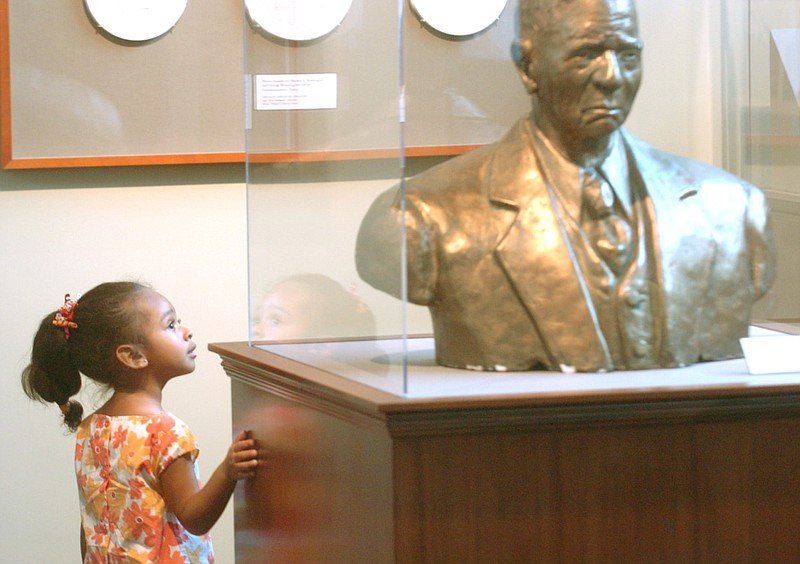
In 1947, Hathaway broke another significant racial barrier when he introduced ceramics at the all-white Alabama Polytechnic Institute as director of ceramics. Hathaway worked there until retirement in 1963, at the age of 91. Throughout his life he received many awards, including honorary degrees, doctorates, or fine arts awards from various colleges and universities where he helped introduce ceramics as a field of study.
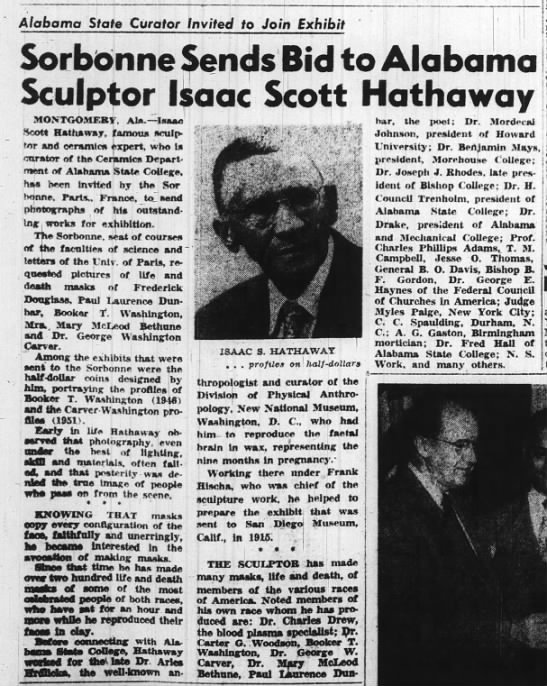
Hathaway said that he believed “that the art of a people not only conveys their mental, spiritual, and civic growth to posterity, but convinces their contemporaries that they can best portray in crystallization their feelings, aspirations, and desires.”
 Isaac Scott Hathaway’s pioneering work, long career and educational legacies provide a fascinating story of strength, perseverance and creative talent as part of the greater American experience. Hathaway died in Tuskegee in 1967 at the age of 95. Yvonne Giles, director of the Isaac Scott Hathaway Museum in Lexington, Kentucky, said, “No one ever thought anybody of importance could have ever come out of Davis Bottom, and he did. Very quiet, very assertive young man that rose out of a time period when this wasn’t supposed to happen. He had no role models. Had none. His family, economically, wasn’t of the upper, middle-class. It’s just an amazing story.”
Sources and Resources
Isaac Scott Hathaway.com – Biography
https://aaregistry.org/story/isaac-hathaway-a-pioneer-in-sculptor/
https://www.explorepinebluff.com/post/meet-isaac-scott-hathaway
https://voyageurmedia.org/wp-content/uploads/2014/06/Hathaway_bio_full_sm_06_30_14.pdf
