



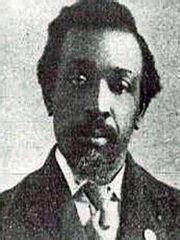
 Henry Boyd was a carpenter, business owner, and abolitionist. He was born a slave in Kentucky at the turn of the 17th century. He lived to buy his own freedom, run a successful and revolutionary business, and help countless people escape slavery as a conductor in the Underground Railroad.
Boyd was born on April 17, 1802. He worked multiple jobs to earn enough money to purchase his freedom. As a boy Boyd was apprenticed out to a cabinet maker. He had a tremendous talent for carpentry.
His woodworking skills and his strong work ethic combined to provide a path out of slavery and poverty.
At the age of 18, he purchased his freedom. At 24, he moved from Kentucky to Cincinnati – using almost all of his remaining funds. He faced discrimination and in spite of his talent was forced to work as a stevedore, unloading cargo from the many steamboats at the city’s public landing. Still, he proved his loyalty and hard work ethic and was promoted to janitor at a carpentry store. When another carpenter was too drunk to install a counter for the store owner, Boyd proved his skills so well that the merchant hired him to build a frame building for him.
Through word of mouth, Boyd’s talent began to break down the racism he originally encountered and enabled him to pick up more contracting jobs, working alongside white carpenters. With the money earned from his store job and the side carpentry projects, he was able to put aside money to purchase the freedom of his brother and a sister.
Henry Boyd accumulated enough money to purchase his own workshop for woodworking.

His furniture shop soon grew to encompass four buildings located at the corner of Eighth and Broadway in Cincinnati. In his workshop, Boyd invented bed frames of his own design, the Boyd Bedstead. This was an improvement over existing bedframes of the day.
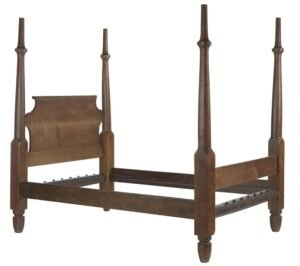

His bedsteads were the feature of the business and in 1833, his invention was patented by George Porter, since African-Americans at the time were unable to legally secure patents themselves. His creative design, called “wood screw and swelled rail” allowed the frame to remain tightly assembled without the use of iron bolts, making for a sturdier fit to endure more stress.
“Henry Boyd, Broadway, above Eighth street. This establishment has long enjoyed a distinguished reputation for bedstead work of high finish, fancy style, and excellent quality, although its operations are not confined to that article alone. Boyd works twenty hands.
The peculiarity of Boyd’s bedsteads-which are the patent right and left, wood screw, and swelled rail-is the solidity of fit, when put together; which enhances their durability; as well as forms a perfect protection from vermin, which find no harbor at the joints.” – Cist, Charles. Sketches and Statistics of Cincinnati in 1851. Cincinnati: W. H. Moore, 1851.

Despite the barriers put in his way, his bed and shop that made it flourished. The wealth he accumulated from his work allowed for him to house his family in a dwelling on New Street in downtown Cincinnati.
Not only was his bedstead breaking new ground, so were Boyd’s work practices. Employing 20-50 people at any given time, he operated an integrated workplace. He and his family believed in miscegenation, and hired whomever was best suited for the job – Black or white. This practice made enemies in the community, and Boyd’s workshop was burned down by arsonists on three separate occasions. He was not able to purchase insurance after the third fire and closed his business in 1862, however his business success allowed him and his family to live out his retirement, crafting furniture out of his home through 1870.
Throughout the years leading to the Civil War, Boyd was active in the Underground Railroad as a conductor.
Well known in abolitionist circles, Boyd would house runaway slaves in an alleged secret room he had built that could shelter up to five people. Stories were told of his use of cabinets and chests to hide fugitive slaves on their journey north to freedom.

So active was Boyd in the Underground Railroad, that many others of the time, such as abolitionist Huntington Lyman, thought Boyd’s home was the first stop once across the Ohio River and not the home of Levi Coffin. His home was welcoming to the needy as well. It is said he took care of a man of over 100 years of age who had been left at the riverfront to die.
Henry Boyd lived in his New Street home until his death on March 1, 1886. He is buried in Spring Grove Cemetery.
Sources and resources
https://nmaahc.si.edu/object/nmaahc_2012.113.1a-m
https://www.americanlegacytours.com/blog/89
http://www.diggingcincinnati.com/2014/02/henry-boyd-former-slave-and-cincinnati.html
https://www.eachoneteachone.org.uk/henry-boyd/
